Quick answer: Industrial floor coatings in Columbus 2026: epoxy ($3–$7 / sf) for general warehouse and light industrial, urethane ($5–$10 / sf) for chemical-exposure and food/beverage, polyaspartic ($7–$12 / sf) for fast-turn auto and aerospace with same-day return-to-service, and polished concrete ($3–$8 / sf) for retail-grade industrial and showroom floors. Substrate prep (shot blast or diamond grind) is 30–50% of the total and the #1 source of failure when skipped.
In this guide
Updated June 2026. Built from real PaintWerks industrial floor coating projects across Central Ohio including Core Molding Technologies (330,000 SQ FT, Hilliard). Reviewing a coatings spec for a warehouse, plant, or auto facility? Schedule a free walkthrough or call 614-582-4227.
Four Floor Coatings, Four Different Jobs
“Industrial floor coating” is not one product. It is four product families with very different chemistry, install requirements, and price points. The right answer depends on what rolls across the floor (forklifts? mop carts? chemicals?), how fast you need to be back in operation, and what the floor needs to look like when it is done.
1. Epoxy — The Industrial Workhorse
Two-part thermoset coating. Cures by chemical reaction (not evaporation). Hardens to a tough, chemical-resistant film that bonds to properly prepped concrete. The default for warehouse floors, light manufacturing, and storage. Cost: $3 to $7 per square foot installed including substrate prep. Cure time: 24 to 72 hours to walk-on, 7 days to full chemical resistance. Color and flake options available.
Where it belongs: warehouses, distribution centers, light manufacturing, storage facilities, gym floors, basement floors. Where it fails: direct UV exposure (yellows), heavy chemical exposure (use urethane instead), surfaces that need to return to service same-day.
2. Urethane — Chemical & Food/Beverage Grade
Two-part urethane (sometimes called polyurethane cement). Tougher than epoxy in chemical and thermal-shock conditions. Handles steam cleaning, caustic washdowns, hot/cold cycling, and aggressive chemical spills. The standard for food and beverage plants, breweries, dairies, meat processing, and any facility that gets hosed down at end of shift. Cost: $5 to $10 per square foot installed. Cure time: 24 to 48 hours.
Where it belongs: food and beverage processing, dairies, breweries, pharmaceutical plants, chemical facilities, any floor that gets washed daily. Where it fails: over-spec for general warehouse use (epoxy is cheaper and works fine).
3. Polyaspartic — Same-Day Return-to-Service
A specialized polyurea coating that cures in 1 to 2 hours. UV-stable (unlike epoxy). Same chemical and impact resistance as urethane. The premium pick when downtime is the cost driver. The floor can be coated overnight and trucks can roll on it the next morning. Cost: $7 to $12 per square foot installed (the premium). Cure time: 1 to 2 hours walk-on, 24 hours to full chemical resistance.
Where it belongs: auto dealerships, auto repair, aerospace hangars, retail showrooms, exterior-exposed industrial floors, any facility where 7 days of curing means lost revenue. Where it fails: on a general warehouse where the downtime cost does not justify the 60% to 100% premium over epoxy.
4. Polished Concrete — The Honest Show Floor
Not a coating. A mechanical process. Diamond-grinding the existing concrete progressively finer (50 grit, 100, 200, 400, 800, sometimes 1500 or 3000) until the surface reaches a glass-like finish. Sealed with a penetrating lithium or sodium silicate densifier. The hardest, most durable industrial floor available because the surface IS the concrete, not a film over it. Cost: $3 to $8 per square foot. Cure: ready as soon as the seal dries.
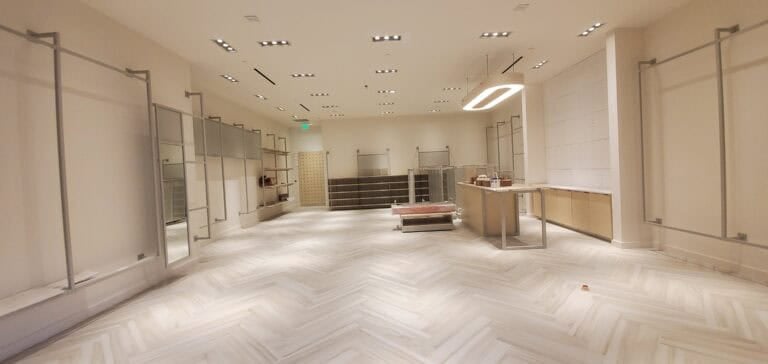
Where it belongs: retail-grade industrial (Apple Store, Whole Foods, Tesla showrooms), aircraft hangars, automotive showrooms, modern warehouses with brand-standard floor aesthetics, museums, restaurants. Where it fails: on existing concrete with deep oil staining, cracking, or surface damage (those need fill before polish).
"The number one source of industrial floor coating failure is skipped or undersized substrate prep. Not the product. Always the prep."
Side-by-Side Comparison
| System | Cost / SF | Cure | Best Use | Weakness |
|---|---|---|---|---|
| Epoxy | $3 – $7 | 24–72 hrs walk; 7 day full | Warehouse, light industrial, storage | Yellows under UV; chem limit |
| Urethane | $5 – $10 | 24–48 hrs | Food/bev, dairy, chem, washdown | Over-spec for general warehouse |
| Polyaspartic | $7 – $12 | 1–2 hrs walk; 24 hr full | Auto, aerospace, retail showroom | Premium price, install window |
| Polished Concrete | $3 – $8 | Same day | Brand-standard retail, hangars | Needs sound substrate; not a coating |
Substrate Prep — Where Floor Coatings Live or Die
The most expensive line item in any floor coating bid is not the coating. It is the prep. Skip it and the system fails inside 18 months no matter what you spent on the topcoat.
- Shot blast. The gold standard for industrial floor prep. Pneumatic propulsion of steel shot at the concrete surface, removes laitance, opens the pore structure, leaves a CSP (concrete surface profile) of 3 to 5. Required for epoxy and urethane on most industrial floors.
- Diamond grind. Mechanical grind with diamond-tipped discs. The required prep for polished concrete. Also used for thin-mil epoxy or polyaspartic where shot blast would be too aggressive. Leaves CSP 1 to 2.
- Crack and joint repair. Every static crack and control joint gets filled with semi-rigid polyurea before the coating goes on. Otherwise the joint telegraphs through and the coating fails at the seam within months.
- Moisture testing. Calcium chloride or RH probe test before any coating. Concrete with too high moisture vapor emission rate (MVER) needs a moisture mitigation primer or the coating debonds.
- Substrate-specific primer. Match primer chemistry to the topcoat (epoxy primer under epoxy, urethane primer under urethane). Saves callbacks at 6 to 12 months.
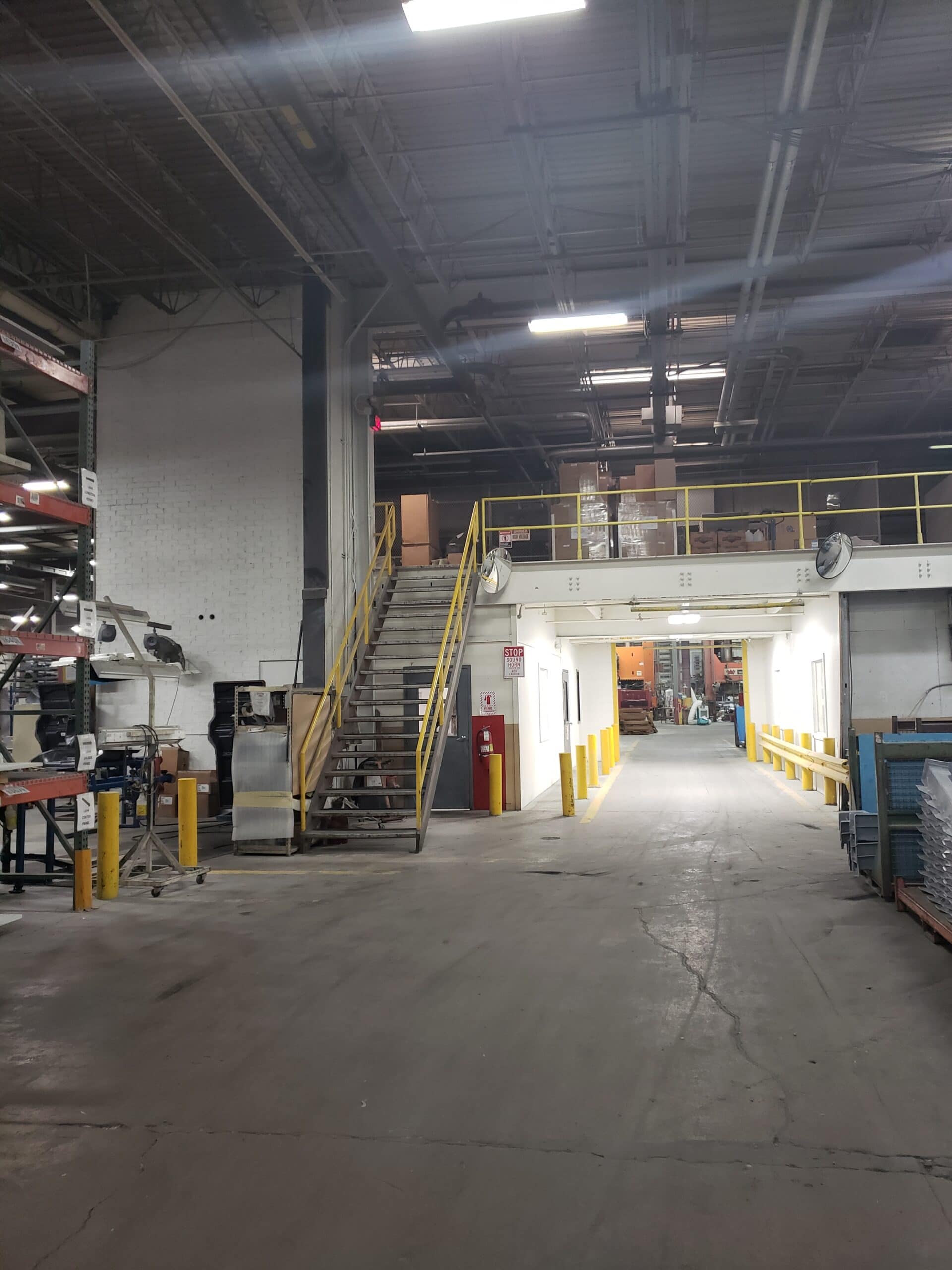
On the Core Molding Technologies project in Hilliard (330,000 sq ft), the substrate prep took two weeks before any coating went down. That investment is what makes the floor still look new five years later.
How to Pick: A 4-Question Decision Framework
Walk these four questions with your facility manager, GC, or coatings rep before signing a bid. The answers will route you to the right system without overpaying.
- How much downtime can the facility absorb? If the answer is "we close Friday night and reopen Monday morning," polyaspartic or polished concrete is the only option. If the answer is "we can shut down for a week," epoxy or urethane work.
- What rolls across the floor? Forklifts and pallet jacks: epoxy is fine. Sit-down lift trucks with hot tires from outside: urethane handles it. Aircraft tugs with hydraulic fluid leaks: polyaspartic or urethane. Heeled customers in a retail showroom: polished concrete.
- What gets spilled or washed? Water and standard cleaners: epoxy. Daily caustic washdown, hot brine, citric: urethane. Aviation fluids, brake cleaner, harsh solvents: urethane or polyaspartic. Nothing aggressive: polished concrete.
- Does it need to look like a finished floor or a working floor? Brand-standard retail and showroom: polished concrete or high-gloss polyaspartic with flake. Industrial back-of-house: epoxy or urethane in solid color. Aesthetics and budget are inversely correlated.
Frequently Asked Questions
Properly prepped and installed: epoxy 5 to 10 years, urethane 7 to 15 years, polyaspartic 8 to 15 years, polished concrete 20 plus years (it is the concrete itself). Service environment shortens these significantly. Heavy chemical exposure or hot-tire pickup can cut life in half.
UV exposure breaks down the aromatic chemistry in standard epoxy. Indoor floors are fine. Floors near loading docks, large windows, or exterior-exposed floors yellow within 6 to 24 months. If UV is a factor, spec polyaspartic or urethane instead.
Yes if the existing coating is sound and well-bonded. We test adhesion in three areas, scuff sand the surface, and apply a bond coat before topcoating. If the existing floor is failing in spots, those areas need full removal and recoat. Mixed-condition floors get a uniform recoat after the failing areas are cut out.
Chemistry. Epoxy is a thermoset that cures in 24 to 72 hours. Polyaspartic is a polyurea variant that cures in 1 to 2 hours. Polyaspartic is UV-stable, epoxy is not. Polyaspartic costs 60 to 100 percent more. Pick polyaspartic when downtime is the cost driver or UV is a factor; otherwise epoxy is the value choice.
No. It is a mechanical process of grinding the existing concrete with progressively finer diamond pads (50 to 3000 grit), then sealing with a penetrating densifier. The finish is the concrete itself, not a film over it. That is why it lasts decades.
Two-day minimum for prep, one day for primer, one day for topcoat, 24 to 72 hours cure to walk-on. Plan a 5 to 7 day shutdown for a standard industrial epoxy. Polyaspartic compresses this to 2 to 3 days total.
Most epoxy and urethane systems are spec’d as primer + base coat + topcoat. The topcoat is the wear layer. Polyaspartic systems are often primer + single self-leveling polyaspartic coat. Polished concrete uses a penetrating densifier instead of a topcoat. Always ask what the manufacturer’s system spec is and follow it.
For a 400 sq ft garage, possibly. For an industrial facility, no. The shot blast prep alone requires equipment that costs more to rent than a pro install of the same square footage. Moisture testing, joint repair, mix ratios, and pot life on two-part products are unforgiving. DIY industrial floors fail within 12 months.
Get a Floor Coating Spec Reviewed
Reviewing an industrial floor coating spec for a warehouse, plant, auto facility, or new commercial buildout? We will walk the facility, check the substrate, and tell you which system fits the use case and which would be over- or under-spec. Forty-five minutes onsite. No pressure.
See our full warehouse and industrial painting services or commercial services hub.